




By Clara Nwachukwu
The International Renewable Energy Agency (IRENA), today, released a new report that shows investment in renewables can provide nearly 60% of Nigeria’s energy demand in 2050.
The country-specific report says such an investment is cost‑effective, will deliver economic growth and jobs, while achieving global climate and sustainable development objectives.
It added that renewable energy sources will enable up to 40% savings in natural gas and 65% in oil needs at the same time.
The report, titled: Renewable Energy Roadmap Nigeria, Renewable-Energy-Roadmap-Nigeria noted noted that “With a growing population and a range of socioeconomic challenges, Nigeria requires sustainable energy sources to meet the growing needs for all the sectors of its economy and achieve universal access to modern energy services.”
IRENA explained that the Renewable Energy Roadmap was developed in collaboration with the Energy Commission of Nigeria, with analyses on additional renewable energy deployment potential up to the year 2050, with an additional 2030 focus to aid shorter-term policy development.
It said: “The study encompasses all key sectors of the Nigerian energy system to provide additional context for energy policy discussions on how increased ambition in terms of renewable energy – beyond current government policy and targets – can be realised.
“Renewable energy can help Nigeria not only meet its energy needs, but also power sustainable economic growth and create jobs while achieving global climate and sustainable development objectives.”
The actions needed to realise this future are multi-faceted and include policy, regulatory and financial related actions to place Nigeria on the path to a transformative future.
The study is said to carefully designed to capture the realities facing the country and sharpen its focus on key challenges and opportunities facing the Nigerian energy system.
“The actions needed to realise this future are multi-faceted and include policy, regulatory and financial related actions to place Nigeria on the path to a transformative future.”
Achieving sustainable energy mix
The Roadmap also demonstrates how renewable energy technologies are key to achieving a sustainable energy mix and meeting the country’s growing needs.
Commenting, IRENA’s Director-General, Francesco La Camera, said: “By using its abundant, untapped renewables, Nigeria can provide sustainable energy for all its citizens in a cost-effective manner.”
He added that “Nigeria has a unique opportunity to develop a sustainable energy system based on renewables that support socioeconomic recovery and development, while addressing climate challenges and accomplishing energy security.”
Similarly, Nigeria’s Minister of Science, Technology and Innovation, Dr. Olorunimbe Mamora, who wrote the Foreword to the Roadmap, said: “The highly distributed institutional structure of the energy sector in Nigeria means that coordination of policies will be essential to unlocking integrated energy transition planning and ensuring its success.
“A cross cutting agency or body tasked with doing so would be helpful in building consensus and developing a coherent plan which in turn would allow for the scaling up of renewable energy to meet the needs across the Nigerian energy sector.”
The former lawmaker in the upper legislative house of Nigeria’s National Assembly argued that sustainable energy is the driver of modern development, adding, “Availability of adequate, reliable, sustainable and cost-effective energy is important for the socio-economic development of any nation.”
He further noted that “Nigeria is endowed with abundant renewable energy resources – namely solar, wind, hydro and biomass – that can be harnessed to scale up its energy supply and achieve universal energy access, energy security and the reduction of greenhouse gas emissions for climate change mitigation.
“Energy consumption in the country is expected to continue to increase due to a rising population and improvements in the socio-economic life of the people.”
Findings of report
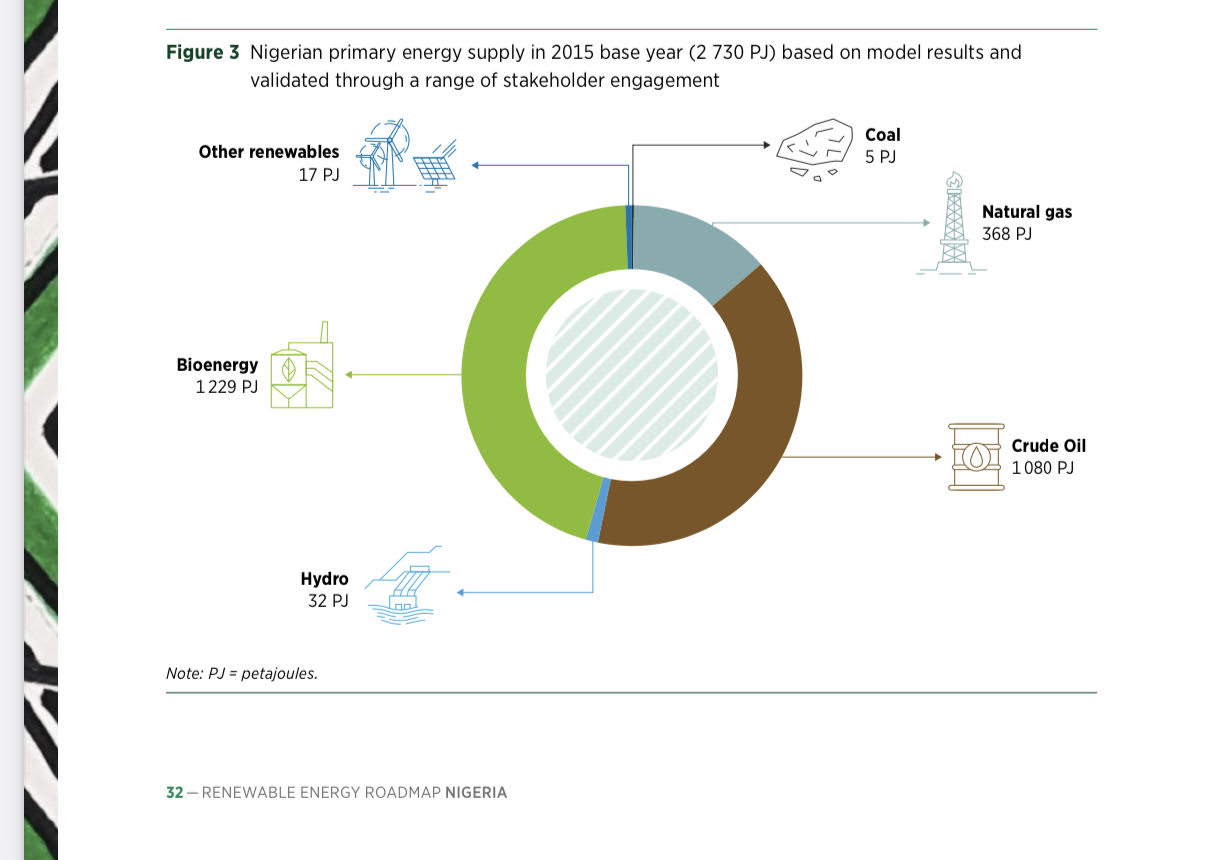
IRENA’s report finds that the share of primary energy requirements met with renewable energy can reach 47% by 2030 and 57% by 2050.
Others are:
- Electrification will play a significant role in achieving higher renewable energy shares with electricity in final energy use nearly doubling by 2050.
- Investment in renewables will be more cost-effective than the conventional pathway.
- Energy Transition Scenario has lower investment costs than planned policies, $1.22 trillion compared to $1.24 trillion respectively. This corresponds to $35 billion versus $36 billion yearly, respectively.
- Advancing the energy transition requires a shift and scaling-up of investments in the short-term to avoid locked-in fossil fuel infrastructure investments with long lifetimes such as natural gas pipelines.
- In 2050, significantly less use of natural gas and oil compared to planned policies has profound implications for infrastructure investment in fossil fuels, increasing the risk of stranded assets.
IRENA concluded by insisting that policies for the accelerated deployment of renewables are needed to unlock the report’s benefits, noting that policy coordination is essential to unlocking successful integrated energy transition planning in Nigeria.


