


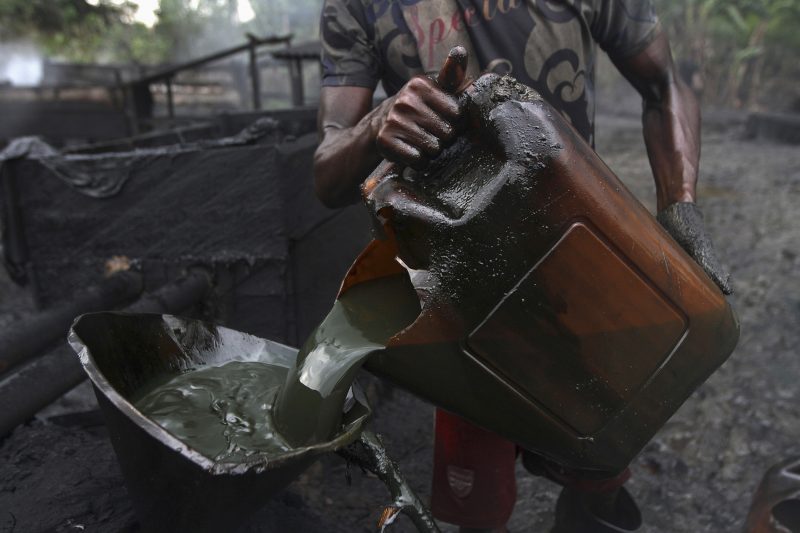
Security agencies yesterday accused some Ministries, Department and Agencies (MDAs) as well as oil companies and communities in the Niger Delta of colluding to steal Nigeria’s crude oil.
The security agencies said this when they appeared before the House of Representatives ad hoc committee investigating crude oil theft and loss of revenue accrued from oil and gas in Abuja.
The representative of the Nigerian Army, Brig-Gen. Gabriel Esho, from the Department of Operations, also cited other contributory factors to include inadequate or obsolete infrastructure, functional healthcare, electricity supply.
Esho said actors responsible for oil theft are often encouraged by Federal Government’s agencies and the international actors are the main perpetrators by lifting crude oil beyond approved license.
He said there is also sabotage on the part of employees of oil companies, adding that the issue around the overlapping effect of militancy was also a factor.
He noted that due to the huge market demand for products, there is a massive community involvement in bunkering and illegal refineries.
To stem the tide, Esho called for local involvement and investment in technology, prosecution of oil thieves, legalising local refineries and remodeling of existing pipelines.
The Representative of Nigeria Police, Alabi Abiodun, also accused the Federal Government’s agencies of playing a role in oil theft and some oil companies because of their skills including domestic and foreign involvement.
He said the Police has established a task force to assist other security agencies in arresting those attacking oil facilities.
He listed the factors responsible for oil theft to include attachment of people to their land, adding that they assumed that they must have a say or benefit from their land.
He said this often forced them to embark on illegal activities whenever they felt neglected, adding that the inaccessibility of some of the areas by the Nigeria Police also gave room for illegality in the region.
In addressing the menace, Abiodun suggested that perpetrators of the dastardly act should be handed over to the Nigeria Police to prosecute them properly.
He said holistic implementation of the Petroleum Industry Act (PIA) would also give the community more sense of belonging.
Furthermore, he said the exhibit should be accompanied with suspects when they are being handed over to the Police.
We are not represented in what is loaded on the ground and this is disturbing. We see pilfering of oil wells and pipeline that can easily be breached in the Niger Delta.
Negative impact
Also speaking, Air Vice Marshall Hassan Abubakar in charge of operation, who represented the Nigeria Airforce, said oil theft has impacted negatively on the economy.
He expressed worry on the quantum of theft, and asked: “Are we sure that the money gotten from oil theft is not what is used to destabilise this country?”
He said the Navy had been carrying out surveillance, adding that the “challenge is that our access is limited,”
“So, what we decided is to have a dedicated access to only the Niger Delta and we need the help of the National Assembly.
“Over 90 per cent of oil theft takes place in the night, some of the courses I have attended only solve half of the problem. Only a kinetic approach can go far to solve the problem.”
Also speaking, Rear Admiral Zacharia Muhammad, Chief of Training, who represented the Nigerian Navy, argued that addressing the issue of oil theft requires collaboration.
He said: “We must facilitate law and policies to ensure collaboration and facilitate the return of the Nigerian Navy to monitor key production facilities.
“We are not represented in what is loaded on the ground and this is disturbing. We see pilfering of oil wells and pipeline that can easily be breached in the Niger Delta.”
He listed factors that aid oil theft to include collaboration and syndicates because oil theft cannot be executed by one agency alone, adding that it involves value chains along oil production.
“We have people that compromise including domestic and foreigners who are all culpable.”
Office of the National Security Adviser (ONSA), the Department of State Security Service (DSS) and Norwagian Embassy represented by Mr Eivind Fjestald, Business Counsellor, were at the committee.


